Until a couple of years ago, I always thought hackathons were meant for highly technical people with coding experience. Participating in one myself was something I had never imagined.
I have spent more than two decades on the functional side of technology, defining problems, designing solutions, and working with technical teams, but I had never developed an application by myself.
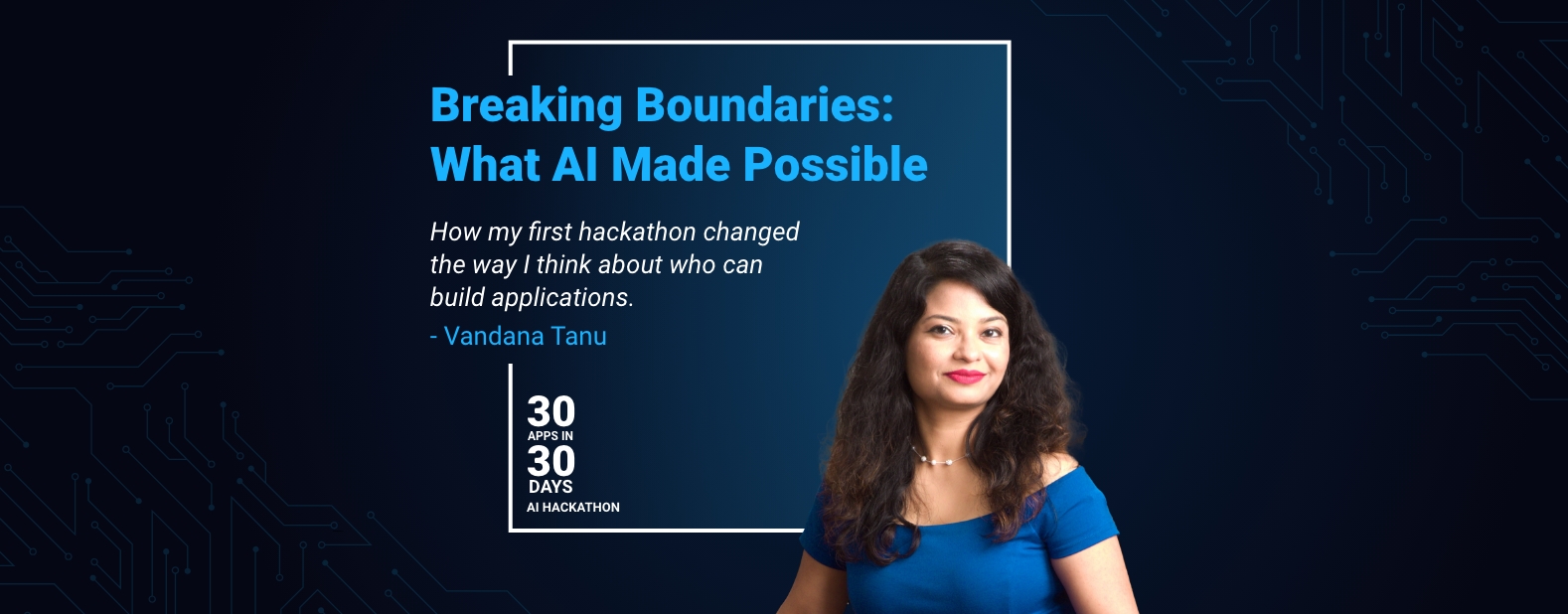
Participating in the Sky Solutions 30 Apps in 30 Days: AI Hackathon challenged me to push my own boundaries, step outside my comfort zone, and explore a space I had never been in before.
I am grateful to Sky Solutions for creating an environment that encouraged everyone, especially those of us without traditional coding backgrounds, to participate and experiment. What started as my first hackathon ended 30 days later with a working product and the Greatest Business Impact Award.
Starting with the Problem: The Common Pain Point
When I decided to participate in the hackathon, I did not have a particular technology or AI model in mind. I started with a problem I had seen repeatedly throughout my career.
In many organizations, a significant amount of critical knowledge lives with people or is scattered across fragmented and outdated documentation. When experienced SMEs move on or retire, some of that institutional knowledge leaves with them. New employees can spend months developing the context they need to become fully productive. Even experienced team members may spend days researching an unfamiliar area when a new change is introduced.
The challenge becomes even greater when teams need to assess the impact of that change. Understanding what may be affected often means searching through system documentation, past requirements, Jira stories, release notes, training materials, process documents, and other repositories. When multiple teams are involved, knowledge can also become fragmented or interpreted differently as it moves between people.
Even after significant manual analysis, there is still a risk that an important downstream impact may be missed, only to surface later during implementation or after the change goes live.
That became the idea behind ProcessForge AI.
Idea to Solution: ProcessForge AI
ProcessForge AI is designed to help organizations connect their existing knowledge and use AI to understand the impact of change and automate artifact generation.
Teams can define the ecosystem they are working within and connect relevant knowledge sources such as system documentation, Jira, Confluence, GitHub, and other enterprise repositories.
When a new directive, policy, requirement, or proposed change is introduced, ProcessForge AI uses that surrounding organizational knowledge to assess potential impacts across business processes, systems, design, data and reporting, training, and compliance. It can also identify gaps, generate open questions, and document assumptions.
The solution then translates those findings into actionable outputs such as epics, user stories, test cases, training materials, traceability matrix, and release communications, which can be ingested by downstream tools such as Jira and TestRail.
The goal is simple: Automate impact analysis and documentation while creating a persistent source of organizational knowledge that does not walk out the door when people do.
Business Impact: The Road Ahead
The potential impact goes beyond productivity. It could help shorten project timelines, reduce manual effort and cost, preserve institutional knowledge, and allow teams to make more informed decisions earlier in the delivery lifecycle. I anticipate ProcessForge AI could improve overall efficiency by reducing the time spent on these activities by approximately 60–70%.
I see ProcessForge AI evolving beyond impact analysis and artifact generation into a broader delivery-intelligence platform that can support the development lifecycle as well. Generated requirements could eventually be used to support code generation and application development, potentially reducing development effort significantly.
That is where I see the next chapter of ProcessForge AI beginning.
The Real Breakthrough: From Defining to Building
The biggest lesson from this hackathon was not about coding. It was about what becomes possible when business knowledge, curiosity, and AI come together.
This experience made me realize that AI is not only changing the products we build. It is also changing who can build them.
Domain experts who deeply understand a problem no longer have to stop at describing what a solution should do. With the right tools, curiosity, and willingness to experiment, they can participate much more directly in building it.
I entered my first hackathon with an idea based on a problem I understood and came out of it having built a working product.
For me, that was the real breakthrough: realizing that AI can help me move beyond defining ideas and bring them to life myself.
About the Author
Vandana Tanu is a Lead Business Architect and a Product Manager at Sky Solutions. Vandana has extensive experience in IT consulting, specializing in Pega, Salesforce, PeopleSoft Financials, SQL and Oracle Databases. She holds a master’s degree in project management and a bachelor’s in computer applications.