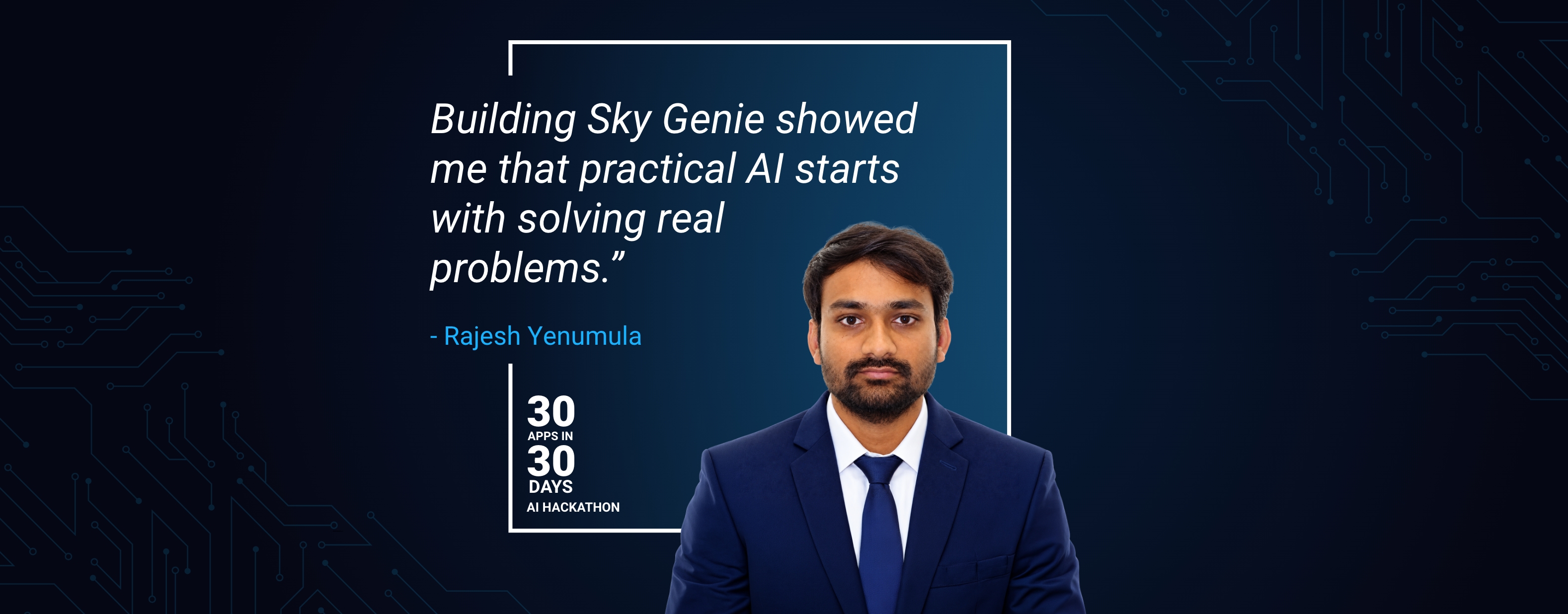
In the second spotlight of our “30 Apps in 30 Days: AI Hackathon” winner series, we feature Rajesh Yenumula, recipient of the “Most Likely to Be Implemented” award. Rajesh shares his hackathon experience, the journey behind his winning idea, and what inspired him to turn an AI concept into a practical solution with real-world potential.
Some of the best ideas start with a problem that seems almost too simple. For me, it was this: employees often know that an answer exists somewhere but finding it can take far longer than it should.
Workplace information can be spread across handbooks, PDFs, benefits pages, IT notes, policies, and facilities instructions. A simple question can quickly become a search exercise or lead to a support request. I wanted to see if AI could make that experience simpler, faster, and more useful.
That idea became Sky Genie, my entry in the 30 Apps in 30 Days: AI Hackathon, where I was excited to receive the award for Most Likely to be Implemented.
Building an AI Helpdesk That Knows When Not to Guess
Sky Genie is a local-first AI helpdesk assistant designed to answer employee questions using approved internal documents. Employees can ask questions such as how many PTO days they receive or how to reset a VPN password. Sky Genie searches the relevant documents, provides a concise answer, and shows the source.
But answering questions is only part of the idea. If a question cannot be answered safely or requires human intervention, Sky Genie creates a structured support ticket for an administrator to review.
That distinction was critical. I did not want to build an AI assistant that simply generated an answer to everything. I wanted it to recognize the limits of what it knows and provide a clear path to human support when necessary.
Why Local-First AI Mattered to Me
From the beginning, I wanted to explore whether the solution could use a local AI model, so sensitive internal information would not need to be sent to external cloud-based LLM APIs.
I used Ollama for local AI capabilities, including local embeddings and optional local LLM-based answer generation. ChromaDB supports document retrieval, while SQLite handles application data. The application itself was built using Python, FastAPI, Streamlit, REST APIs, PDF ingestion, and Docker.
ChatGPT and Codex also played an important role throughout the hackathon. I used them to help design and build the application milestone by milestone, from the backend and frontend to document ingestion, retrieval logic, testing, documentation, and Docker setup.
The Biggest Challenge Was Getting the Answers Right
The hardest part was not simply connecting an LLM. It was making the answers consistent, concise, and grounded in the right approved document.
Early versions sometimes produced answers that were too long, retrieved information from the wrong section, or responded inconsistently to straightforward policy questions. I addressed these issues incrementally by improving document ingestion, routing questions by division, strengthening ChromaDB retrieval, adding source-backed responses, and introducing a fast extractive answer mode.
I also built in fallback ticket creation and targeted fixes for common policy questions. Tests and live Docker checks helped ensure the application could run locally and produce reliable results.
Turning AI Into a Useful Workflow
The hackathon reinforced an important lesson for me: an AI application is not just an LLM connected to a chat interface.
The real value came from connecting several pieces. Sky Genie understands the question, identifies the relevant division and category, retrieves trusted information, provides a concise answer with a source, and knows when it should stop and ask for human help.
The admin side completes the workflow. Support teams can review tickets, filter requests, update status, and view audit logs from a simple dashboard.
The potential benefits are practical. Sky Genie can save an estimated three to five minutes on a common employee question, reduce repetitive helpdesk requests, and cut the effort involved in creating tickets. For a small team handling around 100 repeated questions a week, that could translate into roughly five to eight hours saved each week.
What I Learned
My biggest learning from the project was that useful AI depends as much on the surrounding workflow as it does on the model.
Trusted documents, retrieval, clear sources, controlled responses, human review, security, and user experience all matter. A fast answer is useful only when people can trust where it came from.
The moment that made the idea feel real was when a simple question like, “How many PTO days do I get per year?” could be answered instantly from an approved document with a clear source. That was when I could see Sky Genie moving beyond a hackathon concept and becoming something genuinely practical.
The biggest surprise was how quickly a simple idea could grow into a working local-first workflow with document search, concise answers, safe fallback, ticket creation, admin review, and audit logging.
That is what I hope people take away from Sky Genie. AI does not always have to solve a complicated problem to be valuable. Sometimes, making an everyday process faster, safer, and easier is the most useful application of all.
About the Author
Rajesh Yenumula is a Full Stack BPM Developer at Sky Solutions with over 11 years of experience designing and delivering enterprise business process automation solutions. He specializes in BPM, Bizagi, .NET, SQL, APIs, and modern web technologies, with extensive experience building scalable workflows, integrations, and process-driven applications. Rajesh is also passionate about applying AI and emerging technologies to solve real-world business challenges and improve operational efficiency.